Explore a curated mix of 2-stage model rockets designed for hobbyists and young inventors. This guide highlights five high-quality kits that balance challenge with safety, offering insights into assembly, flight potential, and engine compatibility. Each option pushes altitude limits while teaching the fundamentals of rocketry, timing, and payload experimentation. Read on to compare key features and find the right 2-stage rocket for your next outdoor launch.
| Product | Height | Flight Altitude | Recommended Ages |
|---|---|---|---|
| Estes 1320 Mayhem | 33.6 in | 2,100 ft | 10+ |
| Estes 9728 Vogel Pro Series II | 64.5 in | 2,000 ft | 18+ |
| Two-Stage Super Chief II RK-1032 | >30 in | Not specified | Intermediate |
| Daedalus RK-1003 | Not specified | High altitude (2-stage) | All ages with caution |
| Estes 7276 Checkmate | 17 in | 900 ft | 10+ |
Estes 1320 Mayhem 2-Stage Model Rocket Kit

The Estes 1320 Mayhem kit is an advanced two-stage building project suited for ages 10 and up. The kit features a durable body tube, molded nose cone, laser-cut fins, a recovery parachute, and detailed decals. It requires Estes rocket engines, starters, recovery wadding, a launch pad system, and four AA alkaline batteries for launch (sold separately). Its design supports a two-stage flight with a maximum altitude around 2,100 ft, depending on engine choice. The build time is estimated around three hours, and the kit includes a clear payload section for experiments or lightweight payloads. Engine compatibility spans D12-5 and E12-6 for single stage, D12-0 and E12-0 for boost, and D12-5, D12-7, E12-6, E12-8 for the upper stage.
What to know: This kit is a strong pick for aspiring rocketeers who want to plan one or more experimental flights, optionally pairing with a Porta Pad II Launch Pad and E Launch Controller (sold separately). As with all high-power model rockets, adult supervision is recommended for younger builders, and preparation for accurate staging is essential for successful flights. The kit emphasizes educational value alongside robust performance.
Estes Vogel Pro Series II 2-Stage Rocket Kit

The Vogel Pro Series II kit is built for experienced rocketeers aged 18 and older. It features precision-molded parts, a streamlined nose cone, two recovery parachutes, detailed decals, and a complex build that harnesses a two-stage booster. Engine compatibility includes various Pro Series II engines for the single and booster stages, enabling a projected altitude near 2,000 ft. The 64.5-inch tall rocket requires a launch pad and controller, plus rocket engines, starters, and recovery wadding (sold separately). This model emphasizes high performance and display quality, suitable for seasoned hobbyists seeking a challenging but rewarding build.
Considerations: The kit’s complexity makes it less suitable for casual beginners, but it provides a structured path to mastering staging, stability, and recovery in a larger format. Storage, transport, and a robust outdoor launch area are practical prerequisites for successful flights. Pairing with the Pro Series II launch equipment can improve setup reliability and repeatable results.
Two-Stage Model Rocket Kit Super Chief II RK-1032

The Super Chief II RK-1032 is a two-stage adventure that supports both single-stage and two-stage flights. It uses D or E Estes motors for the first stage and B or C motors for the second stage, though motors are not included. The kit is described as intermediate, with a height exceeding 30 inches, a plastic nose cone, an ejection baffle (no wadding required), and pre-marked tubes for easier assembly. This design helps builders practice alignment, staging, and aerodynamics in a hands-on way. The large size adds a dramatic presence on launch day while keeping assembly approachable for enthusiastic hobbyists.
Key points: It’s well-suited for backyard or club launches with appropriate safety measures. Builders should plan for motor compatibility and staging timing, ensuring a suitable launch environment and readiness to deploy the recovery system on both stages. The included components emphasize straightforward construction with clear instructions to support a successful two-stage flight experience.
Daedalus 2-Stage Flying Model Rocket Kit RK-1003

The Daedalus RK-1003 is a 2-stage high-altitude rocket kit designed for enthusiasts who want a robust launch system. It uses D and E Estes motors (not included), includes self-adhesive decals and an ejection baffle (no wadding required), laser-cut fins, centering rings, a plastic nose cone, and an 18-inch plastic parachute. The kit also points readers to an included assembly video and instructions to facilitate accurate construction and optimal staging. The focus is on achieving high altitude with reliable staging, making it a compelling option for experienced builders seeking a precise, repeatable flight profile.
Practical notes: Prospective buyers should verify engine availability and safety gear, including a suitable launch pad and controller. The Daedalus kit benefits from careful alignment of components and a well-timed ignition sequence to ensure clean staging and a stable ascent.
Estes 7276 Checkmate Rocket-Building Kit
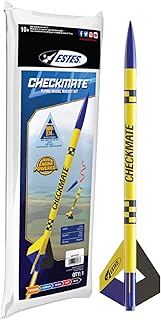
The 7276 Checkmate kit offers an advanced two-stage experience with a high-swept nested-fin design. It includes rocket parts, decals, a recovery streamer, and clear instructions. It requires mini rocket engines, starters, recovery wadding, a launch pad system, and four AA batteries for launch (sold separately). The kit stands at 17 inches tall and can reach up to 900 ft using compatible mini engines (A3-4T, A10-3T for single stage; A10-0T for boost, and upper-stage configurations with A3-4T, A10-3T). This option balances a compact form with solid two-stage performance, appealing to stadium- or field-launch enthusiasts looking for a precise, portable project.
Buying Guide
Key considerations when selecting a 2-stage model rocket kit:
- Target skill level: From beginner-friendly to expert-grade, choose a kit that matches building experience and willingness to handle complex staging.
- Altitude potential: Higher altitude often requires larger rockets and stable weather conditions; verify engine compatibility and recommended launch environments.
- Engine compatibility: Review which Estes engine lines the kit supports (D, E, or Pro Series II) and ensure availability of compatible motors.
- Assembly time and complexity: Some kits require several hours of precise construction, while others offer a quicker build with fewer steps.
- Payload options: Look for kits with payload compartments or clear sections for experiments and sensors to extend educational value.
- Recovery system: Parachute-based recoveries reduce damage; check if the kit includes or requires wadding and baffles to protect the altitude sensor or electronics.
- Launch equipment: Many kits assume you’ll have a launch pad, controller, and batteries (sold separately). Factor these into total setup costs.
- Safety and regulations: Familiarize yourself with local launch rules, field dimensions, and safety distances; always supervise youth launches with proper protective eyewear.
- Durability and accessories: Consider laser-cut fins and high-visibility decals for durability and aesthetics, especially for longer-term display or club use.
Comparative overview: For younger builders or newcomers, the Estes 1320 Mayhem and Checkmate provide approachable yet rewarding two-stage projects with clear assembly guidance. For advanced hobbyists seeking scale and display quality, the Vogel Pro Series II challenges with a larger size and more complex setup, though it demands more skill. The Super Chief II RK-1032 and Daedalus RK-1003 offer substantial altitude potential and require a deeper understanding of staging and engine choices. When pairing with dedicated launch gear and proper safety practices, these kits provide robust pathways to mastering multistage rocketry.
Add a Comment