Exploring the butterfly life cycle through puzzles offers a hands-on way for children to grasp growth, metamorphosis, and sequence. This guide highlights five top butterfly-themed life cycle puzzles that blend education with safe, engaging design—ideal for preschool and early elementary learners in the United States.
style=”display:none;”>Summary Table of Chosen Products
| Product | Brand | Key Feature |
|---|---|---|
| Montessori Wooden Puzzles for Kids Ages 4-8 | Xylolin Store | 4-layer life cycle with progressive piece counts |
| Life Cycle of A Butterfly | 31 Piece Wooden Multilayered Puzzles | Ekoplay Store | Final butterfly stage with 31 pieces |
| Butterfly Growth Cycle Biological Model | Hvogvok Store | Four figurines showing eggs to butterfly |
| TOY Life Life Cycle Toys Puzzles | TOY Life Store | 4 large pieces for early learners |
| 3D Wooden Puzzle Board Multilayer Educational Toy | jojofuny Store | Compact, portable multilayer design |
Montessori Wooden Puzzles: 4-Layer Butterfly Life Cycle

The Montessori wooden puzzle from Xylolin Store presents a clear, layered progression of a butterfly’s life cycle. With 20 pieces total, each layer grows in size to emphasize sequence and time. The design uses basswood and water-based paints for a safe, durable finish, suitable for regular play and early learning environments. This puzzle supports hands-on learning as children observe spawn to larva, to pupa, and finally to butterfly, reinforcing memory through progressive assembly.
Life Cycle of A Butterfly: 31-Piece Wooden Puzzle
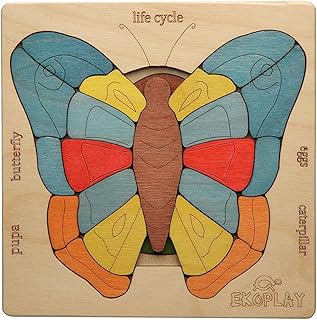
From Ekoplay Store, this 31-piece multilayered puzzle focuses on the full journey from egg to adult butterfly. The puzzle is designed for ages 3 and up, with fine craftsmanship and non-toxic, water-based colors. Smooth edges and burr-free pieces make it suitable for young learners building hand-eye coordination, spatial reasoning, and patience. It also doubles as a thoughtful gift for holidays and birthdays, encouraging hands-on exploration without screens.
Butterfly Growth Cycle Model: Educational Figurines

This Hvogvok Store set includes four figurines—eggs, caterpillar, chrysalis, and butterfly—providing a tactile way to explore each growth stage. The realistic details aid visual learning, while the compact set supports group demonstrations and homeschool lessons. A note on usage: the package is designed for children ages 3 and up, with choking hazard considerations to keep small parts away from younger siblings.
TOY Life Life Cycle Puzzles: 4 Large Pieces

This 4-pack from TOY Life Store introduces nature’s life cycles with large, kid-friendly pieces. Each puzzle focuses on a single life cycle—sunflower, frog, chicken, butterfly—offering varied subjects within one educational bundle. The wooden construction uses non-toxic paints and smooth edges to promote safe, independent play while building cognitive skills like sequencing, memory, and fine motor control.
3D Wooden Puzzle Board: Multilayer Animal and Plant Themes

The 3D wooden puzzle board from jojofuny Store offers a compact, portable way to explore multiple layers of imagery. With a multilayer design and safe wood construction, this puzzle encourages imaginative play while developing eye-hand coordination. Its travel-friendly size—about 7.1 by 7.1 inches—makes it suitable for on-the-go learning, classroom use, and quiet time at home. The butterfly life cycle concept can be explored alongside other animal and plant themes in this set.
Buying Guide: Key Considerations for Butterfly Life Cycle Puzzles
- Age and Skill Level: Select puzzles aligned with a child’s age (3+, 4-8) to ensure appropriate challenge without frustration. Multilayer designs typically suit older preschoolers and early elementary learners best.
- Materials and Safety: Look for solid wood with non-toxic paints and smooth edges. Avoid pieces with sharp corners or easily breakable components for younger children.
- Educational Focus: Consider whether the puzzle emphasizes sequencing, memory, hand-eye coordination, or science concepts like metamorphosis. Some sets include figurines or staged scenes that reinforce narrative understanding.
- Piece Count and Complexity: Start with fewer pieces and straightforward stages, then progress to larger, more complex layouts as the child gains confidence in spatial planning.
- Durability and Longevity: Cards and boards that resist wear-and-tear—especially with frequent handling—offer longer-term value in households and classrooms.
- Storage and Portability: Compact designs and detachable layers benefit families on the go or those with limited play spaces.
- Gift Potential: Puzzles with tiered themes (butterfly, frog, chicken) can be grouped as a learning set or chosen individually as party favors or classroom rewards.
Across these selections, learners gain awareness of biological growth, natural cycles, and the wonders of transformation. Parents and educators can integrate these puzzles into guided activities that pair physical puzzle assembly with discussion prompts about each stage, climate influences on life cycles, and real-world observations in gardens or local habitats.
Add a Comment