Finding the right toys for three-year-olds can support early cognitive growth, fine motor skills, and problem-solving in a fun, engaging way. The following five products are designed to challenge young minds, promote hand-eye coordination, and encourage independent exploration. Each item blends learning with play, using magnets, shapes, counting, and color matching to build foundational skills that set the stage for later schooling.
| Product | Brand | Key Benefit |
|---|---|---|
| LiKee Open Ended Wooden Shape Puzzles | LiKee | Spatial awareness, color and shape recognition, problem solving |
| MOTREE Preschool Learning Toys | MOTREE | Early numeracy, counting, and basic operations |
| Magnetic Wooden Fishing Game | NASHRIO | Alphabet and number recognition, fine motor skills |
| Montessori Wooden Board Game with Colorful Sticks | Zeewoo | Fine motor control, color matching, spatial reasoning |
| MTYOKILN Magnetic Color & Number Maze | MTYOKILN | Color, number recognition, counting skills |
These selections cover a range of play types—from puzzle assembly and pattern building to magnetic logic and counting challenges—ensuring a well-rounded approach to cognitive development for preschoolers. Each product uses durable materials and safety-focused design to keep playtime constructive and worry-free for parents and caregivers.
LiKee Open Ended Wooden Shape Puzzles

The LiKee puzzle set includes 36 wooden shape pieces, 60 pattern cards, and two iron tins for storing pieces. Children can replicate patterns shown on cards or design their own configurations, supporting spatial awareness and color and shape recognition. The dual goal approach—matching patterns and creating new designs—engages kids in problem solving and hand-eye coordination as they manipulate pieces to fit different layouts.
MOTREE Preschool Learning Toys

This Montessori-inspired set focuses on counting and basic arithmetic through tactile manipulatives. It includes a wooden finger board, 13 number blocks, eight flash cards, and a holder. Designed for homeschool or preschool use, the kit helps children visualize addition and subtraction within ten, building a concrete understanding of numbers and operations. The hands-on approach also promotes fine motor development and engages curiosity about mathematical concepts.
Magnetic Wooden Fishing Game
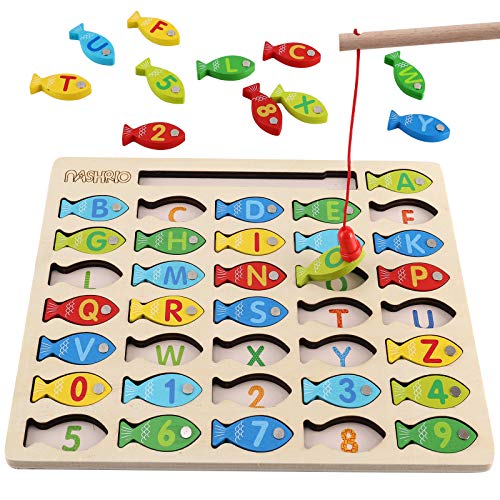
The NASHRIO fishing game combines a wooden board with colorful fish carrying letters and numbers. Children use a magnetic pole to catch fish, which aids color, letter, and number recognition while enhancing dexterity and hand-eye coordination. Crafted from polished wood with non-toxic finishes, this toy supports safe, engaging learning as kids practice sorting, matching, and early literacy skills during play.
Montessori Wooden Board Game with Colorful Sticks

Zeewoo’s classic multi-player board game draws inspiration from iconic towers and emphasizes modular play. It supports 1-6 players and is adaptable for ages 4-8, though the design also serves 3-year-olds in a simpler mode. The activity integrates fine motor skills, color matching, spatial reasoning, and social play, making it a versatile educational toy for families or classrooms. Durable wooden construction and careful finishings enhance safety and long-term use.
MTYOKILN Magnetic Color & Number Maze

The MTYOKILN maze centers on magnets and color-number recognition. With 55 magnetic beads in ten colors and a playful ice cream motif representing numbers 1–10, children practice counting, color matching, and fine motor control by guiding beads along a track with a magnetic pen. This Montessori-aligned setup encourages focus, patience, and problem-solving while providing a visually engaging, hands-on counting activity for 3- to 5-year-olds.
Melissa & Doug Pattern Blocks And Boards

Melissa & Doug Pattern Blocks and Boards provides 120 wooden tiles in various shapes, five double-sided puzzle boards, and a portable storage box. This open-ended, screen-free activity builds spatial awareness, hand-eye coordination, and early math skills through sorting, matching, and pattern creation. The assortment supports extended play by offering numerous ways to complete patterns and explore geometric relationships, ideal for group or solo play sessions.
Buying Guide: Key Considerations For Cognitive Toys
When selecting cognitive toys for three-year-olds, consider the child’s current development stage and the specific skills you want to nurture. The following factors help evaluate options across features, materials, and usability:
- Learning objectives: Choose toys that explicitly target cognitive areas like pattern recognition, counting, spatial awareness, and problem solving. Toys that combine multiple skills offer broader developmental benefits.
- Age-appropriateness and safety: Ensure the toy is designed for preschoolers, with smooth finishes, rounded edges, and non-toxic materials. Look for small parts or choking hazards to avoid for younger toddlers.
- Durability and care: Wooden and high-quality plastic components tend to endure more playtime and travel. Consider if the toy is easy to clean and store, as clutter-friendly designs support consistent use.
- Open-ended vs. structured play: Open-ended sets (like pattern blocks and building blocks) promote creativity, while structured activities (counting boards, pattern cards) reinforce specific concepts. A mix provides balanced development.
- Social and solitary use: Some toys support solo exploration; others encourage cooperative play. Multi-player options can foster communication, turn-taking, and collaborative problem solving.
- Portability and set-up: For travel and classroom use, consider the weight, assembly requirements, and whether pieces are contained in a storage solution to prevent loss during transit.
- Engagement duration: Look for toys that hold attention through graduated challenges or expandable activities. This helps sustain motivation as a child grows.
- Ease of supervision: Choose items with clear instructions or intuitive play mechanics that adults can easily guide without dominating the activity.
In essence, a well-rounded cognitive toy collection for a three-year-old blends tactile exploration, counting and patterning, and spatial reasoning with opportunities for social interaction. Each product listed above offers different pathways to cognitive growth while remaining age-appropriate and safe for daily play.
Add a Comment