Explore realistic marine steam engine kits that transform model ships into authentic, operating demonstrations. This guide highlights five top options, detailing build quality, robustness, and educational value. Each entry includes key features to help you compare craftsmanship, materials, and performance. Whether you are a hobbyist or a classroom educator, these kits provide tangible insights into steam power, propulsion, and marine engineering.
| Product | Brand | Highlights |
|---|---|---|
| Steam Engine Model with Boiler and Lamp Scene DIY Kit | MechPuConToy Store | Full metal build; lifelike beam engine; includes boiler and lamp scene |
| Wilsco Hobby-Technik Classic Working Steam Engine Locomobile | Wilsco | Classic working steam engine; locomobile design |
| Steam Engine Model Kits LS3-13S | LS | Vertical three-cylinder with oil cup; marine scale |
| Saito T1DR-L marine steam engine for boat | ENGINE | Compact single-cylinder; long-stroke design |
| Steam Engine Model Building Kits LS2-13S | LS | Vertical twin-cylinder; durable construction |
Steam Engine Model With Boiler And Lamp Scene

This full metal beam engine kit delivers a lifelike steam demonstration with a miniature boiler and lamp scene, designed for enthusiasts who want a visually impressive model that also functions. The construction emphasizes high-quality materials and precision parts, ensuring a durable display piece that can operate under careful supervision. The kit’s mechanical simplicity makes it accessible for intermediate builders while still offering a genuine steam-driven experience.
Wilsco Hobby-Technik Classic Working Steam Engine Locomobile
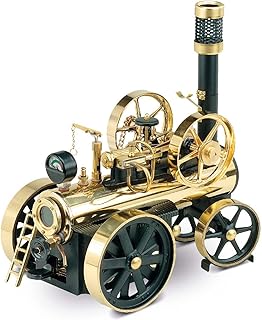
The Wilsco Locomobile provides a classic approach to steam power with a working engine design that evokes early locomotive engineering. While compact in scale, it emphasizes craftsmanship and mechanical clarity, offering an approachable build for hobbyists who enjoy traditional steam technology. Expect sturdy construction and clear demonstration of piston-rod movement within a vintage chassis aesthetic.
Steam Engine Model Kits LS3-13S Vertical Three-Cylinder

This multi-cylinder marine engine showcases a vertical three-cylinder configuration with an oil cup, designed to power model ships from 80 to 120 cm. The triple-cylinder arrangement delivers a visually striking demonstration of synchronized piston action and torque transfer. The package emphasizes robust materials and corrosion-resistant construction for long-term display and operation.
Saito T1DR-L Marine Steam Engine For Boat
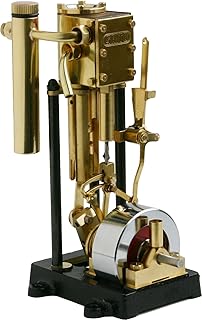
The Saito T1DR-L is a compact, single-cylinder marine engine designed for boats, featuring a vertical boiler and a long-stroke, double-acting arrangement. While smaller in scale, this model emphasizes efficiency, precision, and a clean power delivery suitable for compact model ships. It is well-suited for hobbyists seeking a streamlined propulsion solution with authentic steam characteristics.
Steam Engine Model Building Kits LS2-13S

The LS2-13S kit features a vertical twin-cylinder setup with an oil cup and a durable frame, designed for model ships in the 80-120 cm range. This engine emphasizes realistic marine engineering with enhanced torsional rigidity and corrosion protection. It is ideal for builders who want a robust, future-proof display that remains faithful to authentic steam mechanics while offering resilient performance under repeated demonstrations.
Buying Guide
Key purchase considerations for marine steam engine kits include engine configuration, power output, and scale accuracy. Single-cylinder designs are typically easier for beginners, while multi-cylinder arrangements deliver richer motion but require more careful assembly and maintenance. Material quality matters: metal frames, copper seals, and corrosion-resistant coatings extend life and preserve performance in humid environments.
Assembly complexity should align with your experience and goals. Some kits are ready to run with minimal setup, while others demand careful tuning and calibration of pistons, seals, and lubrication. Consider whether you want a purely display model or a functioning propulsion system that can operate in a simulated seafaring context.
Compatibility with your model ship size is crucial. Ensure the engine’s vertical or horizontal mounting, oil cups, and shaft dimensions fit your hull design and propeller configuration. Look for clear documentation on maintenance procedures, including lubrication frequency and seal inspection, to maximize longevity and reliability.
Educational value is another important dimension. Engines with transparent housings, step-by-step build guides, and historical context help learners understand steam dynamics, heat transfer, and mechanical efficiency. For educators, kits with demonstration-ready features and safety notes offer practical classroom applicability.
From a cost perspective, evaluate long-term value: sturdiness, ease of maintenance, and the potential for repeated use across projects. If you plan to display multiple marine engines, prioritize modular designs that share components and offer upgrade paths. Finally, confirm that the kit’s included hardware and fasteners are of consistent quality to avoid late-stage substitutions that can compromise alignment and performance.
Add a Comment