Discover reliable motors and related propulsion components that power remote control cars. This guide highlights five practical options—ranging from self-centering steering kits and solar-powered builds to compact DC motors—that help kids and hobbyists explore engineering concepts, robotics, and hands-on STEM learning. Each pick includes core features to help you choose the right motor for performance, compatibility, and educational value.
| Product | Brand | Key Feature | Ideal For |
|---|---|---|---|
| Self-Centering Steering Remote Control Car | – | Drifting motion and auto self-centering steering | STEM projects for kids ages 8-12 |
| Solar-Powered Car V1 | Pica Toys Store | Solar and battery hybrid power with wireless remote control | Renewable energy learning for ages 8-12 |
| 6 Pack DC 1.5-3V 15000RPM Mini Motors Kit | California JOS Store | Multiple 130 motors with metal mounts for DIY projects | Arduino and STEM experiments |
| 20pcs Micro 130 DC Motor Kit | – | High-speed 3V-12V motors up to 25000 RPM | DIY remote control toy projects |
| EUDAX 6 Set DC Motors Kit | EUDAX Store | Multiple small DC motors with battery holders and accessories | DIY science projects and hobby builds |
id=”self-centering-steering”>Self-Centering Steering Remote Control Car

This kit combines a responsive steering system with drifting-capable motion, providing a practical platform to observe how steering geometry affects vehicle trajectory. The built-in self-centering feature helps learners understand how caster and alignment influence return-to-center behavior after a turn. The design supports STEM education by encouraging problem-solving and hands-on exploration of mechanical and control concepts.
id=”solar-powered-car”>Solar-Powered Car V1

The Solar-Powered Car blends renewable energy concepts with practical electronics. Learners build a car that runs on solar power and batteries, enabling experiments with different power sources and their effects on performance. The wireless remote control adds an interactive control layer, making it ideal for exploring the basics of remote operation, energy efficiency, and hybrid systems in an engaging, hands-on way.
id=”dc-motor-pack-6″>6 Pack DC 1.5-3V 15000RPM Mini Electric Motors Kit
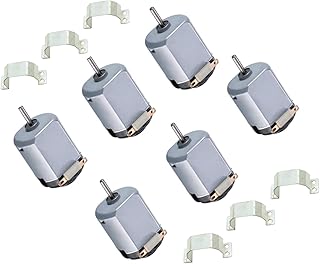
This kit provides a ready-to-use set of compact DC motors with metal mounts, designed for a range of DIY remote control car projects and STEM experiments. With a 3V operation range and a high no-load speed, these motors are suitable for lightweight builds and quick prototyping. The bundle supports longer-term projects thanks to anti-static packaging and versatile applications in electronics and automation.
id=”micro-dc-motors-portfolio”>20pcs Micro 130 DC Motors

High-speed micro motors in a bulk package are ideal for small-scale remote control cars and multi-motor robotics projects. With voltage coverage from 3V to 12V and speeds up to 25,000 RPM, these motors enable rapid testing of gearing, torque, and control strategies. They are well-suited for experimentation in competitive play or classroom robotics labs where multiple units are needed.
id=”eudax-motor-kit”>EUDAX 6 Set DC Motors Kit

The EUDAX motor kit combines six mini DC motors with accessory components, including a battery holder and a basic wiring setup. It emphasizes correct assembly and safe operation, and it supports a variety of DIY science projects. The motors span a broad voltage range (3V-12V) and deliver substantial no-load speeds, making them suitable for experimentation with propulsion and simple robotics builds.
Buying Guide
Key considerations when selecting motors for remote control cars:
- Power and speed: Choose motors whose voltage range and RPM match your build. Higher RPMs enable faster cars but may require more torque or gearing adjustments.
- Torque and gearing: For rugged or climbing models, prioritize motors with higher torque or pair with appropriate gear ratios and pinions.
- Size and compatibility: Check shaft dimensions, mounting holes, and overall footprint to ensure fitment with your chassis and mounts.
- Power source: Decide between batteries, solar, or hybrid options. Solar hybrids introduce renewable energy concepts but may demand additional electronics for regulation and charging.
- Control and responsiveness: For remote control integration, ensure compatibility with your microcontroller or RC receiver and consider PWM control capabilities.
- Durability and safety: Look for motors with robust housings and motor mounts. Follow wiring and insulation guidelines to reduce overheating and shorts.
- Educational value: If the goal is STEM learning, select kits that include clear instructions and opportunities to experiment with physics concepts like friction, drag, and energy transfer.
Add a Comment