For hobbyists and professionals alike, a reliable GPS tracker and FAA compliance module can boost safety, locate lost aircraft quickly, and help maintain regulatory status. This article highlights five top options that integrate GPS tracking, firmware beacons, and compatibility with a range of RC planes and FPV drones. Each entry includes key features, letting you compare performance, ease of use, and integration with existing gear. Use the buying guide to tailor choices to your aircraft size, flight environment, and regulatory needs.
| Product | Brand | Highlights |
|---|---|---|
| Ruko R111S GPS Tracker | Ruko Store | Beeper, FAA compliance, dual positioning |
| SKYRC GNSS Performance Analyzer | SKYRC | GPS+GLONASS, data logging, long battery |
| 2 CH RC Airplane F-22 Ready | WORK | Easy to fly, stability, 2.4GHz control |
| SoloGood M10 GPS Module | SoloGood Store | UBLOX-based, compact, wide drone range |
| SKYRC GSM-015 GNSS Device | SKYRC | GNSS data tracking, versatile use |
Ruko R111S GPS Tracker With Beeper

The R111S integrates a built-in beeper to help locate a lost aircraft quickly. It is designed as a lightweight RID (Remote ID) module for FAA regulation compliance and supports tracking for FPV drones, RC gliders, helicopters, and fixed-wing aircraft. Dual-positioning enhances reliability within typical flight ranges of 500-1000 meters, providing real-time tracking via an accompanying app. The device is compatible with a broad range of drone brands and models, expanding its utility beyond Ruko’s own lineup.
SKYRC GNSS Performance Analyzer

This device combines dual GPS and GLONASS tracking to verify top speeds and customize metrics for drag, track, or flight. It automatically logs data in a 1 MB memory and overwrites older records, ensuring continuous data capture. Powered by a LiPo battery, it can operate for extended sessions, letting you push performance without power concerns. Ideal for RC cars and planes where precise telemetry adds credibility and enhances tuning accuracy.
2 CH RC Airplane F-22 Ready To Fly
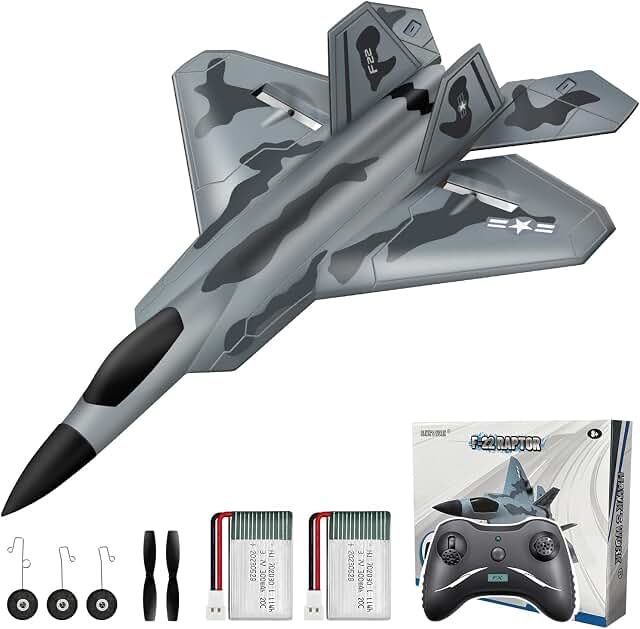
Designed for beginners and hobbyists, this RC plane emphasizes reliability and ease of use. It features a built-in self-stabilization system to simplify flight and reduce crashing risk for newcomers. The foam structure keeps weight down while providing durability, and the 2.4 GHz radio control allows multiple planes to fly with minimal interference. It’s a practical entry point for pilots who want to practice VLOS and shelter-in-place flight techniques before advancing to more complex platforms.
SoloGood M10 GPS Module For RC Drones

The SoloGood M10 GPS module employs a UBLOX-compatible design with a compact footprint suitable for various RC racing and FPV drones. It supports a broad voltage range (3.6V-5.5V) and is built for quick integration with 2–7 inch traversing drones. The module’s performance emphasizes fast, accurate positioning, making it suitable for aerial racing and precision flight applications where reliable GPS grounding is critical for flight stability and data logging.
SKYRC GSM-015 GNSS Remote Speedometer

The GSM-015 device focuses on GNSS-based data tracking for a variety of platforms, including vehicles, RC cars, boats, planes, rockets, and quads. It emphasizes consistent performance and a broad feature set, complemented by durable construction. This versatility makes it a strong option for pilots who operate multiple vehicle types or require a single tracker that can adapt to different flight scenarios and payload configurations.
Buying Guide: Key Considerations For RC Plane GPS Trackers
When choosing a GPS tracker and regulatory module for RC planes, consider the following perspectives:
- Regulatory compliance: If FAA rules apply in your region, verify that the module provides Remote ID capabilities or fits into existing FAA frameworks. Check compatibility with your aircraft’s weight class to ensure adherence to regulatory thresholds.
- Tracking range and accuracy: Evaluate dual positioning options (GPS plus GLONASS) for better reliability, especially in challenging environments. Real-time tracking is valuable for locating lost aircraft quickly.
- Power and endurance: Battery life is critical during long flights or FPV sessions. Look for devices with long-lasting LiPo or other efficient power sources and consider the balance between added weight and endurance.
- Compatibility and installation: Confirm compatibility with your existing controller, flight controller, and aircraft type (glider, multirotor, FPV drone, fixed-wing). Some modules work across brands, while others are model-specific.
- Telemetry and data logging: Telemetry features and automatic data logging enable performance analysis, post-flight review, and fleet management for multiple machines.
- Ease of use and maintenance: Simple installation, app usability, firmware updates, and accessible customer support influence long-term satisfaction and reliability.
- Price-to-performance balance: Weigh feature sets against your budget. A higher upfront cost may be justified by enhanced safety, compliance, and future-proofing.
- Future-proofing: Consider modular designs that can accommodate upcoming updates, additional sensors, or expanded compatibility with new aircraft types and regulations.
In sum, choose a GPS tracker and compliance module that aligns with your aircraft category, flight environment, and regulatory needs. Prioritize reliable positioning, strong logging capabilities, and smooth integration with your control systems to maximize safety and flight enjoyment.
Add a Comment