Discover the best rubber band helicopter toys for kids, classrooms, and DIY makers. These kits teach energy, propulsion, lift, and engineering through hands-on play. Below you’ll find five top options with clear materials, instructions, and classroom-friendly features to spark curiosity and practical learning.
Summary of chosen products:
- Rubber Band Helicopter Kit – 10-Pack (STEM Inventions)
- Rubber Band Helicopter Kit – Build 3 DIY Helicopters (STEM Inventions)
- Rubber Band Helicopter Kit – Build 30 DIY Propeller-Powered Helicopters (STEM Inventions)
- STEM Kit 4-Pack – Rubber Band Helicopter, Scribble Bot, Catapult, Propeller Car
- SCIONE 24 Sets LED Flying Set – Slingshot+Glow Helicopters
Best Rubber Band Helicopter Kit For Classrooms And Home Science
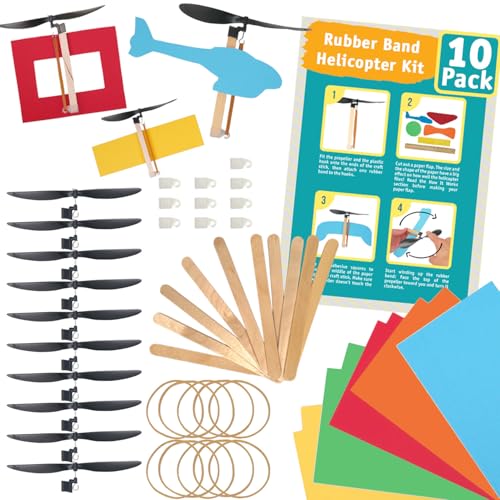
This 10-pack kit from STEM Inventions provides a complete set to build ten rubber band-powered helicopters. It’s ideal for teachers and classrooms, enabling multiple students to explore lift, energy transformation, and propulsion. The kit encourages collaborative learning as groups compare design variations and observe how rubber bands store and release potential energy to generate lift.
Key features include all necessary supplies for ten helicopters, a hands-on entry into basic aerodynamics, and a straightforward setup that supports guided or free exploration. The bundle is well-suited for demonstrations, science fairs, or club activities, offering repeatable experiments across sessions.
Build 3 Rubber Band Helicopters – Simple STEM Project

This kit provides supplies for three durable propellers, card stock, adhesive squares, craft sticks, rubber bands, and a detailed guide. It’s designed to teach lift, drag, propulsion, and energy transformations through hands-on building and experimentation. The clearly illustrated instructions help both students and educators carry out engineering challenges with minimal setup time.
Educational emphasis centers on core physics concepts and classroom-ready activities. It supports iterative testing—students can tweak blade angles or rubber band tension to observe changes in thrust and flight stability, reinforcing inquiry-based learning and scientific reasoning.
Build 30 Rubber Band Helicopters – Large-Scale STEM Project

This expansive kit is built for bigger classrooms or families exploring broader experiments. It includes supplies for thirty helicopters and a detailed creation guide that reinforces energy concepts, lift, propulsion, and energy transfer. The scale encourages collaborative design challenges and long-term projects over several sessions.
Educators can leverage the larger quantity to host competition-style activities or STEAM stations, documenting outcomes as students compare different build techniques, blade designs, and firing tensions to optimize performance.
4-In-1 Rubber Band STEM Kit (Helicopter, Scribble Bot, Catapult, Car)

This 4-in-1 STEM kit introduces kids to multiple physics concepts: energy transfer (catapult), lift and drag (helicopter), propulsion (car), and basic circuitry (scribble bot). The variety supports cross-disciplinary learning across physics, engineering, and design thinking. It’s especially well-suited for homeschool environments or classroom centers seeking diverse activities in one purchase.
Designed for ages 8-12, the kit emphasizes easy, solder-free assembly with illustrated instructions. Students can work independently, with teachers guiding when needed, making it a strong option for project-based learning and NGSS-aligned activities.
PLAYSTEM Rubber Band Aeroplane Low Wing Kit

While marketed as an aeroplane, this kit uses a rubber band mechanism to power a low-wing aeroplane, offering a related hands-on experience in aerodynamics and propulsion. It includes a learning booklet with activities that reinforce concepts such as lift, thrust, and drag, suitable for indoor and outdoor use. The kit provides a straightforward entry point for younger students or beginners exploring rubber band-powered flight.
As a supplementary option, it pairs well with helicopter-focused activities, enabling comparative experiments between rotor-based and fixed-wing flight mechanics to deepen understanding of flight principles.
STEM Inventions 6-Inch Plastic Propellers, 10 Pack

These 6-inch plastic propellers are designed specifically for rubber band-powered builds, including airplanes and helicopters. They feature a built-in metal shaft with a small hook for rubber bands and a plastic mounting system compatible with craft sticks or small balsa wood pieces. The propellers are durable and suitable for repeated flights and classroom demonstrations.
Educators can rely on these propellers as reliable spare parts for experiments, helping students understand how blade design affects lift, thrust, and stability in a practical, hands-on way.
STEM Inventions 6-Inch Plastic Propellers, 30-Pack

This bulk set expands or替 supports larger classroom activities, maker spaces, or after-school clubs. The 30-pack propellers are built for rubber band-powered planes, helicopters, and other propeller-driven projects. The same durable materials and mounting compatibility apply, helping students scale experiments and explore a variety of designs without frequent restocking.
Proponents can use these parts to emphasize iteration—students prototype several rotor designs, compare outcomes, and iterate toward more stable, longer flights while maintaining a focus on energy transfer and propulsion concepts.
Buying Guide: Key Purchase Considerations For Rubber Band Helicopter Toys
- Educational objectives: Identify whether the kit emphasizes physics (lift, drag, propulsion), energy transfer, or engineering design. Choose kits that align with your curriculum goals.
- Quantity and scalability: For classrooms, select bundles that support multiple students and allow iterative testing across groups. Consider future sessions and storage needs.
- Instructions and support: Look for clearly illustrated, step-by-step guides, troubleshooting tips, and teacher resources to reduce setup time and maximize instructional value.
- Materials and durability: Prefer kits with durable props, card stock, and components that withstand repeated flights and minor impacts. Ensure safe, non-toxic materials for kids.
- Safety and supervision: Rubber bands can pose minor hazard; choose age-appropriate kits with simple, safe assembly. Ensure guidance for safe use during activities.
- Compatibility: If integrating with other STEM tools, verify compatibility of propellers, craft sticks, and mounting hardware with your existing kits or classroom supplies.
- Assessment opportunities: Look for design challenges, observation prompts, and guided questions that help measure student understanding of core concepts.
- Storage and organization: Consider kits with reusable containers or clear labeling to support quick setup and tidy storage between sessions.
- Budget and availability: For larger groups, prioritize kits that balance cost with educational value and provide reliable supplier support for restocking.
- Student engagement: Choose visually appealing kits with bright instructions and hands-on activities that sustain curiosity and encourage collaboration.
Add a Comment