Wood rubber band cars offer an engaging way to explore motion, energy, and basic engineering. This article highlights top rubber band car kits made from wood, designed for students and hobbyists. Each selection combines simple assembly with hands-on experimentation to reinforce physics concepts such as kinetic energy, friction, and propulsion. Read on to compare kits, features, and practical tips for classroom or at-home projects.
| Product | Key Feature | Ideal For | |
|---|---|---|---|
| Rubber Band Car Kit (10-Pack) | STEM Inventions Store | Wind-up motorless cars with adjustable bands | Classroom STEM lessons, group projects |
| Rubber Band Car Kit (2-Pack) | STEM Inventions Store | Compact, beginner-friendly builds | Small groups, quick demonstrations |
| STEM Kit – 3 DIY Cars | STEM Inventions Store | Three propulsion methods: rubber, solar, mousetrap | Exploring energy sources and propulsion concepts |
| S&S Worldwide Rubber Band Race Cars | S&S Worldwide Store | Ready-to-paint and race ready | Race-themed activities and events |
| Rubber Band Propeller Car Kit (10 Pack) | STEM Inventions Store | Propeller-driven propulsion with multiple cars | Bulk classroom sets and demonstrations |
These selections provide a spectrum from simple wooden builds to multi-vehicle kits with different propulsion ideas. Each product emphasizes safe, glue-free assembly and clear instructions, making them suitable for diverse learners and settings. The kits also align well with inquiry-based learning approaches, inviting experimentation and mindful observation about how design changes affect speed, distance, and efficiency.
Rubber Band Car Kit (10-Pack): Classroom STEM

This 10-pack from STEM Inventions Store centers on wind-powered wooden cars designed for physics and motion lessons. The kit supports NGSS expectations related to motion, force, and energy, making it a strong choice for science classrooms. Assembly is straightforward with no glue or specialized tools required, enabling quick setup and rapid entry into hands-on exploration. Students can experiment with different numbers of rubber bands and tension to observe how speed and travel distance change, fostering data collection and analysis.
Key features include clear, intuitive parts and step-by-step instructions, with a focus on transforming energy into motion. The multiple cars per package allow for small-group collaboration, comparison of results, and independent testing of hypotheses about propulsion and efficiency. Teachers and parents can structure activities around timing runs, distance tracking, and control tests to showcase the relationship between energy storage and motion.
Rubber Band Car Kit (2-Pack): Quick Builds

The 2-pack from STEM Inventions Store offers compact, beginner-friendly wooden cars suited for short demonstrations or introductory labs. Like the larger kit, it emphasizes real engineering concepts—students wind the rubber bands and release to observe motion and energy transformation. The design prioritizes ease of assembly, enabling rapid prototyping and iterative testing in limited class periods. The smaller scale makes it ideal for quick checks of understanding or for enabling more students to participate in a single lesson.
Educators can integrate this kit into a series of micro-activities: wind speed tests, distance measurements, and friction challenges on different surface types. The emphasis on intuitive assembly reduces downtime, helping students focus on hypothesis formation, data collection, and analysis. The 2-pack format is particularly convenient for paired projects or staggered lab sessions.
STEM Kit – 3 DIY Cars: Solar, Rubber Band, Mousetrap

This 3-in-1 STEM kit from STEM Inventions Store includes a solar-powered car, a mousetrap car, and a rubber band car. It provides a broad view of propulsion methods and energy conversion, supporting students in comparing how each system stores and releases energy. The kit aligns with science standards by exploring kinetic energy, friction, motion, and sustainability through hands-on builds. No tools or soldering are required, with laser-cut parts and illustrated instructions that are classroom-friendly and conducive to both group and independent work.
Using the three vehicles, learners can design investigations that test efficiency across propulsion types, measure speed and acceleration, and track how friction interacts with surface texture. The kit also serves as a springboard for deeper questions about energy sources, environmental impact, and practical engineering design. Teachers can guide students through data collection, graphing results, and interpreting why certain configurations perform better under certain conditions.
S&S Worldwide Rubber Band Race Cars: Prep And Paint

From S&S Worldwide, this craft kit focuses on a race car derby atmosphere with a ready-to-paint and race-ready approach. The kit invites students to customize design and aesthetics while engaging in a competitive, yet educational, activity. The emphasis on painting can enhance fine motor skills and creativity, while the underlying rubber band propulsion demonstrates core physics principles. The race format supports collaborative learning, time-bound experiments, and the practical application of iterative testing to achieve better performance.
Educators can structure events around measurement accuracy, race fairness, and data recording for speed and distance. The materials are suitable for classroom demonstrations, science fairs, or community events. While the primary draw is a fun, sporty activity, it remains anchored in scientific inquiry as students analyze how modifications to wheel alignment, weight distribution, and band tension influence outcomes.
Rubber Band Propeller Car Kit (10 Pack)
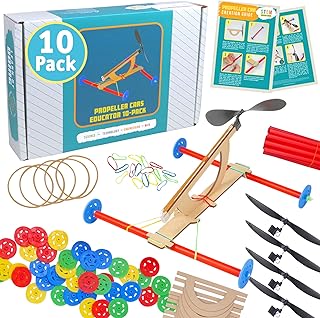
The Rubber Band Propeller Car Kit delivers a propulsion twist with propeller-driven cars. This 10-pack provides bulk classroom capability and allows educators to run larger demonstrations or multiple stations. The propeller adds a dynamic element to the basic rubber-band mechanism, illustrating how propulsive force and propulsion orientation affect movement. This kit supports investigations into propulsion efficiency, air resistance, and rotational dynamics, giving students a broader perspective on energy transfer in mechanical systems.
In practice, teachers can guide students through setting up test runs, recording times and distances, and comparing results across all vehicles. The bulk format makes it ideal for school-wide events or maker days, where many learners can participate in simultaneous experimentation, data collection, and collaborative problem solving.
Buying Guide: Key Considerations For Wood Rubber Band Cars
- Learning objectives: Choose kits aligned with core topics like kinetic energy, force, friction, and propulsion methods. Decide whether you want simple wind-powered builds or multi-propulsion options.
- Age and skill level: Simple two-part kits suit younger students or beginners, while multi-vehicle kits with varied propulsion systems support more advanced learners.
- Materials and safety: Wood-based frames with minimal tools are ideal for safe, classroom-friendly projects. Look for glue-free designs and clearly illustrated instructions.
- Classroom logistics: Assess kit quantity for group sizes, session length, and assessment needs. Bulk sets support larger demonstrations and events, while smaller kits work well for targeted exploration.
- Experiment design flexibility: Ensure the kit allows for adjustable band tension, wheel alignment, and different surface trials to encourage experimentation.
- Assessment and data collection: Prefer kits that enable straightforward measurement of speed, distance, and acceleration. Provide charts or templates for consistent data recording.
- Durability and reuse: Reusable components help with multiple lessons and extended practice. Check for sturdy wooden parts and reusable fasteners.
- Cross-disciplinary potential: Look for kits that integrate science with math (graphs, averages) and engineering design thinking (iteration and optimization).
In summary, wood rubber band cars offer scalable learning experiences—from quick demonstrations to in-depth investigations of propulsion and energy transfer. Selecting the right kit depends on your teaching goals, class size, and the level of inquiry you want students to pursue. The options above provide reliable, safe pathways to observe how simple mechanical systems behave under varied conditions, fostering curiosity and critical thinking in American classrooms and homes alike.
Add a Comment